
The Answer: Practitioner Roundtable
Real talk from practitioners actively optimizing for AEO.




Today's lineup





















Your AEO checklist
Assess where you’re strong and where you still have gaps in your AEO strategy.

Building for AEO: Ownership, agencies, and execution
This webinar helps close the gap between strategy and execution to successfully operationalize AEO.

WEBFLOW AEO · COMING SOON
Own your visibility in AI search.
See how AI engines find your brand. Get prioritized recommendations. Ship improvements. All within Webflow.
[Alexander Diner] When you strip away our logo and our colors and everything that makes us us visually as a brand, are we still distinct when it's just text on a screen?
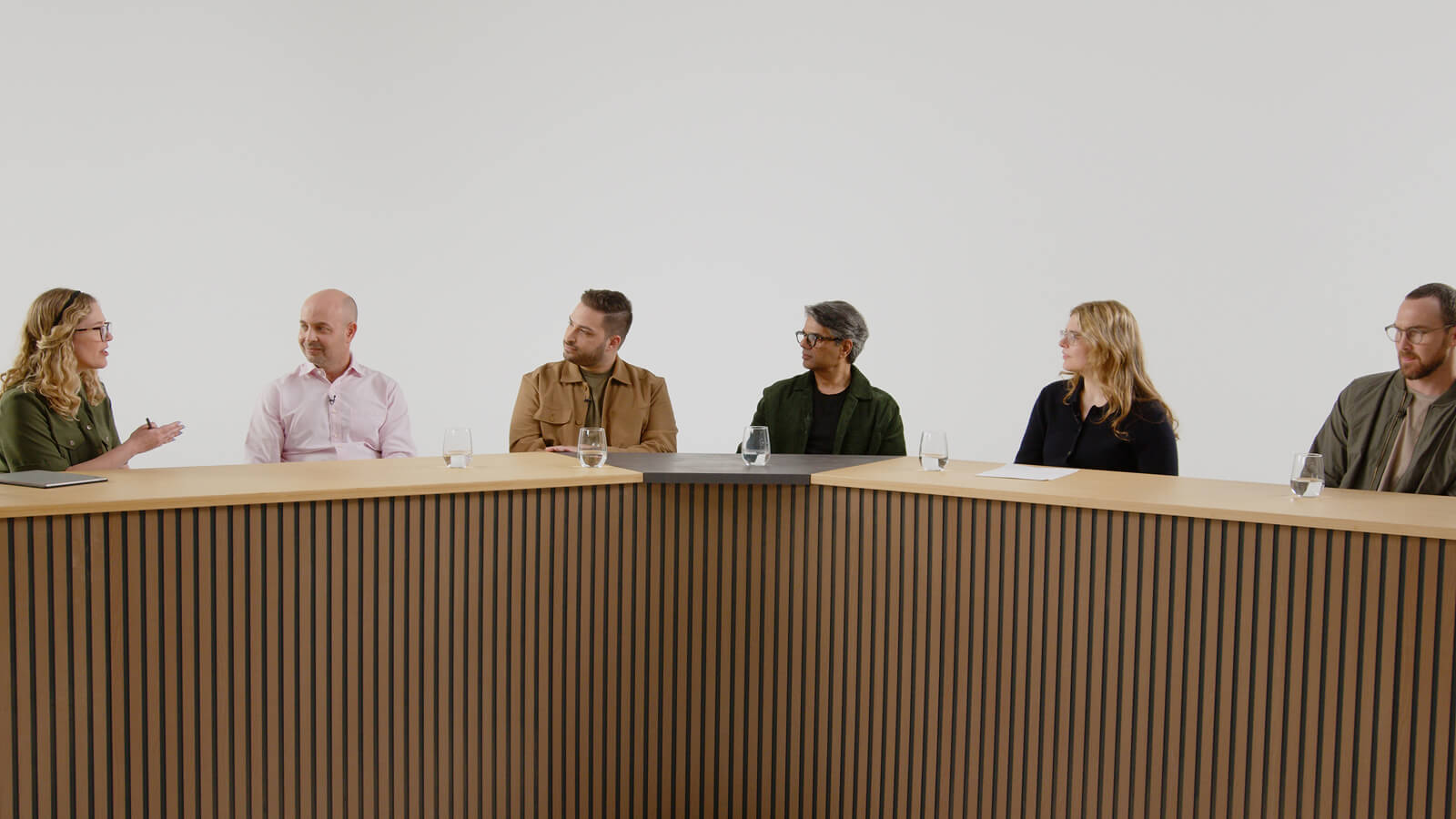
[Jess Fain] Yesterday we heard from the executives and today we hear from the people actually building. And there's a big difference between having a strategy for navigating that and being in the trenches executing it. Today's guests know that difference firsthand. I'm joined by five practitioners who are living this question every day, from agencies to in house teams to the people actually shipping the tools, and yes, even one of our own here at Webflow. Because if we're going to ask the hard questions, we should probably be willing to answer them too.
So let's get into it. Thanks everyone so much for joining us. The proposition we want to talk to you all about today is most companies think they're ready for AEO, think they're ready for AI search, but they're not. And I want to hear whether you agree with that or not. Josh, what about you? What do you think?
[Josh Jacobs] Not only do they feel that they're not ready, they're not sure what ready looks like, they're not sure where to start or even what good is. And that's a really big problem that a lot of our customers are trying to overcome right now.
[Josephine Cahill] I'll give a very scary one for me and my team, which is I got a DM on Slack from one of our sales team who said, Josephine, someone said they found us on ChatGPT and that our price is half of what our price is. And they found a link and it was a page from I think 2021 and we didn't know what to do, we didn't know whether to honor that or not. But they out-negotiated us in that context very well. And we realized we had to get on top of our brand consistency and messaging to be ready for AI search as fast as possible.
[Uzair Dada] It's undefined, and it's undefined by so many different players. Whether it's OpenAI, whether it's Google, whether it's Perplexity, whether it's Claude, everyone is sort of thinking about it differently. So it's very difficult. It's daunting and it's daunting all the way from the leadership team to the practitioner saying what should I do?
[Mason Poe] You know, this question around are we ready? The things that we see from our customers is that there's two camps and I think that people go between them almost daily, if not hourly, which is either boom or doom and how to be able to think about navigating both, I think the excitement and maybe the trepidation. And how to think about how are we going to work our way out of today's job to be able to build for tomorrow. The problem can feel so big in both of those worlds. That sort of narrowing down and getting to that first step is probably the thing that helps to, I think, align everyone from the executives all the way through individual contributors that are working within that space.
[Jess Fain] And so how do you deal in that moment of uncertainty where things are changing so dramatically so quickly? Best practices are emerging overnight, new technologies — how do you prepare your teams for that ever changing world?
[Alexander Diner] The dynamic has shifted and in a lot of ways it's been kind of a rug pull. Like we've been doing decades of SEO where we're essentially gaming for keywords, and now we're kind of reorienting or orienting perhaps for the first time in this way to human language, to the ways that we really think as people and the questions that we actually ask. What it's, I think, illuminating for a lot of brands is that like our positioning maybe was never great, you know, like we didn't actually know how to tell our story. And when someone's just asking an LLM a question about what should I buy for this? Or what solutions exist for this problem. Is the way that Webflow is showing up in that answer unique against our competitors, or does it sound just like the rest of them?
[Mason Poe] Marketing B2B sites is like, oh, we are in a page metaphor. And now what I think we're moving towards is like a conversation metaphor.
[Josh Jacobs] In a world where AI is looking at your content and abstracting it. What's left? Right. We spend all this time fighting over words, fighting over copy. It doesn't even matter if it's at scale, right? In this world where our words are being abstracted for us by the machines, what's left? So I think of it as two things. The first is sentiment — what is the sentiment that we want these humans to take away from our brand? And then the second is, what is the objective truth? What are the facts that these machines need?
[Alexander Diner] Yeah, that's the irony of this moment. The computers and robots and AI, like being able to touch everything is actually forcing us to be more human, speak in the human language, show up in the more human way.
[Uzair Dada] You're trying to do two things. You're trying to get discovered and you're trying to get chosen. Everything sort of falls into those two buckets. But if you just simply break it down, that's what we are trying to solve for. So it's not "or," it's an "and." We've just gotten lazy at not answering the question. And frankly, brands are afraid to answer the question. There are lots of large brands who don't want you to call their child ugly. When you're in their own house, they have a problem with that. But outside of someone calling their child ugly, they're okay. They'll deal with it, but they won't solve for the answers on their own website.
[Josephine Cahill] Our content peaks at around eight months and then it plateaus and drops after that. If we're seeing a 15% decline in organic month over month, that is immediately slated for a refresh. We don't think of AEO as a channel shift, we think of it as a distribution shift. But we do have the collaborative study between Harvard and ChatGPT that said the average prompt-based search in an LLM is 60 words. The average Google search is 3.5 words. Now we can think about that as we have a much harder story to tell here, a much more personalized story, or we can say, oh my gosh, I have all this new information on how to meet people where they're at.
[Uzair Dada] Knowing not just what you're solving for, but who you're solving for. So starting with the understanding of the persona, your ICP, and saying, okay, these are the people I'm trying to answer and not everyone who's coming to my website, what are they trying to answer? What are they trying to research? It's not just about, oh, I used Profound or I used AirOps, or I used something else to get an answer of oh my God, I'm not showing up or my AEO score is great — to am I showing up for the right people? Am I answering the right questions for what they want to do? And use that as a starting point because if you don't have that, it does look like doom. It looks really, really scary.
[Mason Poe] I think probably the other thing that I would see is how brands actually have to be able to say what they're not good at and being very specific around that so that you can help to guide that conversation within these models.
[Josh Jacobs] The first thing that comes to my mind is ownership, because if everybody owns something, then nobody does. At Jasper, that's been one of the biggest challenges we've had to face so far. To become AEO ready is who owns AEO within our company. And it can't just be everybody. It has to be a defined role. It has to be something that is determined and fixed and then charting that towards specific data. What are those metrics that we're tracking towards? What is the type of content that we can create or that we need to create or we need to change to move that needle.
[Josephine Cahill] When you're talking about how we're going to measure this, at its core we're in high school again, it's the scientific method, it's really, really basic. What we're trying to do here is prove out hypotheses. So we're A/B testing different experiments to see what's ranking and what's pulling through and measure our results and then lean into them hard and while doing that really avoid the sort of LinkedIn flurry of what everyone else is telling us. Might work. I mean on a month over month basis it's changing. One month we all care about FAQs one month, we all care about listicles the next month. The only thing that matters is your llms.txt file.
[Uzair Dada] Look at sort of call logs, call transcripts, both internal, external customer success prospect and deduce what are the conversations that are happening. Once I know what the conversations that are happening are, then the measurement of am I there or not is much more meaningful.
[Josephine Cahill] We've scaled out an integration with Gong where what we do internally is we scrape all of our calls every single week and every single month and we analyze that for what questions were asked, what integrations were mentioned, what partners were mentioned, what competitors were mentioned and critically we ask how did you hear about us? And our sales team asks that on every single call consistently. Even in this landscape of really confusing attribution and cookie management questions. And can we track any of this and do we know where they're coming in from? We do have that source of truth for our pipeline to be able to see. What are they saying, where are they coming from and how are we optimizing those channels.
[Uzair Dada] That's amazing.
[Josephine Cahill] I'm such a fan of it.
[Mason Poe] Oh yeah, I want to go and take that and we'll talk after this.
[Josephine Cahill] I'll send you a copy.
[Uzair Dada] The North Star that we almost always miss, but that we just go straight for the measurement. We almost forget to see what's important.
[Mason Poe] Actually dig into your agent analytics and look at what's happening on the robots. That's an area where you can very quickly understand one thing. Are you being indexed? But that's a really easy way to go. And both look at what are your top ranked pages and what are your bottom ranked pages.
[Josh Jacobs] Work on developing the arrangement and groupings within your own site. And while you're in those meetings, maybe also work on technically how you can enable your team to act on that. Once you've determined that ontology.
[Alexander Diner] I think asking the questions in the LLMs themselves and understanding the way that you are being translated and perceived by all of these different great AIs and then looking for the gaps. What is showing up really strong? What is showing up really weak? We have so many tools now and more and more coming to market every day that are helping us understand these rankings. Traffic by LLMs. What's driving that type of traffic? There's more amazing great tools coming to market that will allow us to do this right in the same space where we're building our sites.
[Jess Fain] Agents are now members of your team 100%, but they are really high risk members of your team. They are entry level employees who hallucinate, who make mistakes and who sometimes don't follow the rules. And so I think we think a lot about agentic governance from a lifecycle perspective, from a review and approval perspective. What is a high risk change versus low risk?
[Mason Poe] There's so many tools that are being thrown at us every single day. So I think it's being maybe judicious and skeptical as we're approaching these tools or trying to look at like how does this really solve a problem versus what is being advertised on the box?
[Josh Jacobs] One of the biggest mistakes that I'm hearing about is people only going for that lower hanging fruit, right? Just adding an FAQ here or a schema there, that's going to be like a salve on the wound, right? But it's not going to serve you in the long term. You've got to do the legwork to make sure that your content is organized in a way that tells a cohesive story.
[Josephine Cahill] This is a group of very, very smart people and I'm lucky to be here. None of us are smarter than where these models are going to get to. And the only way that we can win here is with a really thoughtful brand voice, a really consistent story about that brand and high quality, high authority content.
[Uzair Dada] If you can think about what you want to do, these tools give you an incredible amount of superpower to be able to unlock what was not possible prior.
[Alexander Diner] Still be you, still have a strategy, still have a framework, because when we have those things, the AI can help us scale.
[Jess Fain] We said at the top yesterday was the executives and today was the practitioners, the designers, the developers, the people who open the project and do the real work. And what they just told you is that this is more than a strategy problem. It's a design problem, a content problem, a measurement problem. And it needs the people at this table to solve it. You've heard how these practitioners are tackling AI driven discovery across their sites and their clients. Next, we're going to show you how Webflow approaches the same challenge on our own site, the playbook we built and what we learned executing it. I cannot thank you enough to our panelists. Stay with us.